OMNY is replacing NYC’s MetroCard in 2026—bringing contactless convenience, fare capping, and $20M in savings. But can it serve all New Yorkers equitably? A deep analysis.New York has finally joined the global contactless revolution. The bigger question is whether it has done so justly.
On a January morning in 2026, rush hour at Times Square–42nd Street looked almost unchanged: the familiar roar of express trains, the shoulder-to-shoulder choreography of eight million daily riders, the institutional smell of steel and coffee that no urban planner has ever quite managed to eradicate. But something was subtly different at the turnstiles. The magnetic swipe—the nervous flick of wrist that separated real New Yorkers from bewildered tourists for thirty-two years—was gone. In its place, a gentle tap. A green light. A soft chime.
The MetroCard, that gold-hued emblem of New York identity that replaced tokens in 1994 and became a canvas for everyone from the Wu-Tang Clan to David Bowie, ceased sales on December 31, 2025. OMNY—short for One Metro New York, the Metropolitan Transportation Authority’s contactless fare payment system—has officially inherited the city.
It is, by any measure, a remarkable technological transition. Over 90 percent of paid subway and bus trips are now made with OMNY, a system that works with contactless credit and debit cards, smartphones via Apple Pay or Google Pay, and a dedicated OMNY card available at retail locations across the five boroughs. The MTA expects the switch to save at least $20 million annually in MetroCard production, vending machine repairs, and cash collection costs. The contactless era has arrived in New York City—about a decade later than London, and several years behind Singapore and Tokyo. But it has arrived.
And yet, as with all grand modernizations, the real story is in the details. OMNY is simultaneously a genuine leap forward and a cautionary tale about how American public institutions manage digital transformation: boldly conceived, chronically delayed, unevenly distributed, and shadowed by legitimate concerns about equity, privacy, and the perennial gap between the city that technology imagines and the city that actually exists.
What OMNY Is—and How It Works
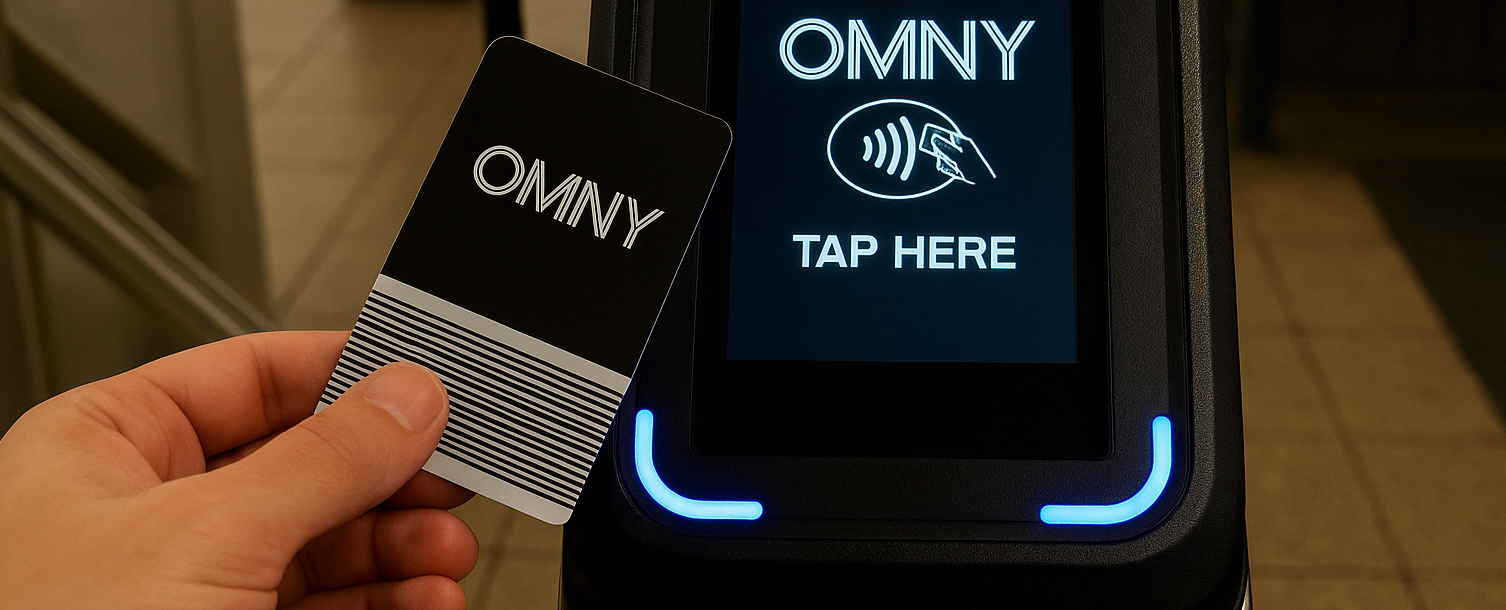
For riders unfamiliar with the system, the basics are elegant. Riders tap a payment method on the OMNY reader at the turnstile or bus farebox and wait for the green check to pass through. Accepted methods include contactless credit, debit or prepaid cards; phones or smartwatches using Apple Pay, Google Pay or similar wallets; and OMNY cards, which are refillable contactless transit cards sold at machines and retailers.
The headline feature, for frequent commuters, is OMNY fare capping. Under the new setup, subway and local bus customers will not be charged for more than 12 rides in a seven-day period, which caps weekly costs at $35 for full-fare riders and $17.50 for reduced-fare customers. This rolling cap—which resets automatically and requires no upfront purchase—effectively replicates the old 7-day Unlimited MetroCard, but without the commitment. A rider who only takes nine trips in a given week pays only for nine. The fare cap is reached, according to the MTA, nearly one million times per month, generating over $8 million in free rides monthly.
There is $40 million of fare value underutilized annually from weekly and monthly MetroCards. By switching to tap-and-go, customers do not have to pre-pay for multiple trips to receive a discount and forfeit what they don’t spend. In purely economic terms, that is a meaningful transfer of value back to riders—particularly those with irregular schedules, second jobs, or unpredictable commutes.
The MTA has also introduced a Day Pass to replace traditional round-trip tickets, valid from the day of purchase until 4 a.m. the following day, costing less than two peak single-ride tickets on weekdays. These are not trivial improvements. They represent, at last, a fare architecture that treats transit as a living, adaptive public good rather than a rigid bureaucratic product.
A Long-Delayed Revolution
The irony of New York’s belated embrace of contactless transit is that the city helped invent it. The MTA began thinking about moving to a smart card-based system as early as 2004. South Korea rolled out its transit smart card in 1995; Hong Kong launched the Octopus card in 1997; London introduced the Oyster card in 2003, and Chicago began transitioning to Ventra in 2013. New York, with its byzantine governance structures, perpetual capital shortfalls, and the structural complexity of 472 subway stations serving one of the most densely layered urban infrastructures on earth, took considerably longer.
The agency initially planned to fully retire the MetroCard by the end of 2023—a timeline repeatedly pushed back due to the pandemic and delays in delivering OMNY card vending machines. An MTA consultant told Gothamist that full deployment may not be completed until the end of 2026. The MetroCard, in the end, survived nearly three years past its intended obituary.
This is not entirely surprising. Major cities around the world, including London and Singapore, have long used similar contactless systems. In the U.S., San Francisco launched a pay-go system in 2025, joining Chicago and others. New York’s scale—a network that carries over three million subway riders on a typical weekday—makes any technology transition exponentially more complex than in smaller cities.
It is worth noting, too, that OMNY carries an interesting genealogical distinction. The company behind OMNY is Cubic, who also developed London’s Oyster system as well as systems for cities like Vancouver and Sydney. In a sense, New York is running a next-generation version of the software that underpins some of the world’s most admired transit payment systems. What makes OMNY architecturally distinct is that it treats the bank card or smartphone—not a transit-issued card—as the primary payment instrument. The OMNY card itself is secondary, an accommodation for those without contactless banking access, not the center of the system’s design philosophy.
That distinction has significant implications for how we evaluate the system’s equity record.
OMNY vs. MetroCard: What Riders Actually Gain (and Lose)
The comparison between OMNY and the MetroCard reveals a system that is genuinely better in most respects—but with meaningful gaps.
What OMNY does better:
- Fare capping eliminates the need to guess how many trips you’ll take weekly
- Free transfers within a two-hour window on any tap (bus to subway and back), using the same card or device
- 24/7 reloadability at thousands of retail locations, online, or at station vending machines
- Balance protection — unlike cash-loaded MetroCards, registered OMNY cards or linked bank cards can be replaced if lost or stolen
- $20 million in annual system savings, freeing funds for service improvement
- Near-instantaneous ridership data for operational planning, versus the week-long delay MetroCard data required
What riders miss:
- The 30-day unlimited pass, discontinued with the MetroCard, has no direct OMNY equivalent—only the rolling weekly cap
- Riders accustomed to checking their balance at the turnstile must now use the OMNY website or app
- Some riders, particularly older New Yorkers, find the vending machines for reloading OMNY cards more cumbersome than MetroCard machines. As one 70-year-old Manhattan rider told Fortune: “It’s hard for the elders. Don’t push us aside and make it like we don’t count.”
The Equity Problem: Who Gets Left Behind?
The most serious critique of OMNY is not technical. It is structural.
A 2023 study found the system was more widely adopted in wealthier and predominantly white neighborhoods. Usage in lower-income areas still lags, which raises equity concerns that the MTA has yet to fully address. This disparity is not incidental—it reflects the fundamental challenge of designing a system built around bank cards and smartphones for a city where significant populations are unbanked or underbanked.
The OMNY card offers a partial remedy. Riders without credit or debit cards can purchase an OMNY card with cash and reload it at participating retailers or vending machines. The fare-capping feature is available to customers who use a digital wallet, a contactless debit/credit card, or an OMNY card. Reduced-fare OMNY cards for seniors and people with disabilities exist, and Fair Fares OMNY cards for low-income residents became available in February 2025.
But availability is not the same as accessibility. The psychological and logistical distance between a cash-dependent household and a tap-and-go transit system remains real. Community advocates have pointed out that the MTA’s outreach to non-English-speaking communities, undocumented immigrants wary of creating digital footprints, and elderly riders resistant to new technology has been inconsistent. The system’s equity promise—leave money in riders’ pockets through automatic fare capping—can only be realized by riders who successfully navigate the transition.
OMNY Student Card Problems: A Cautionary Case Study
Nowhere have the equity tensions been more visible than in the rollout of student OMNY cards—and they deserve extended treatment, because they illustrate precisely how good policy intentions can stumble on poor implementation.
In September 2024, over half a million New York City students received OMNY cards for the first time, offering up to four free rides per day, year-round. This was a genuine upgrade from the previous MetroCards, which offered only three daily rides during limited hours on school days. Students could now ride to internships, weekend jobs, and extracurriculars with unprecedented freedom. The city paid $50.5 million for 1.5 million cards.
The problems became apparent within months.
The cards are made of paper-thin material, making them easily damaged by everyday use. Schools advised against laminating them—which could affect NFC functionality—yet students reported cards stopping working after getting wet or being bent. Some students waited over a month for replacement cards. In a city where a missed subway ride can mean a missed class, job interview, or medical appointment, these delays carry real consequences—particularly, as Chalkbeat reported, for recent immigrant families afraid that turnstile-jumping could attract law enforcement attention.
The fraud-detection algorithm introduced its own complications. The MTA flags OMNY cards for potential fraud and alerts the education department if it detects a card isn’t being used regularly near the school where it was assigned. Some cards have been deactivated outright because they’re used at offbeat locations. Privacy advocates at the Surveillance Technology Oversight Project raised immediate concerns: the system effectively tracks student movement, creating a digital map of where each child travels each day, without explicit parental consent or clearly defined retention limits.
MTA CEO Janno Lieber acknowledged the physical shortcomings of the student card material, noting that the goal is to get student transit credentials onto phones within two years. A digital student OMNY card pilot is now planned for the 2026–2027 school year. It is an encouraging development—but it arrives after a year of disruption that fell disproportionately on some of the city’s most vulnerable young commuters.
OMNY Privacy Concerns: The Data Beneath the Tap
Perhaps the most underreported dimension of OMNY’s rollout is what happens to the data generated every time a New Yorker taps through a turnstile.
Based on OMNY’s terms of service and privacy policy, the tap-to-enter terminals collect smartphone device identifiers, location data, payment information, billing address, the point of entry to the transit system, and occasionally even user content on social media platforms.
These datapoints—logged not by the MTA or the city but by for-profit corporation Cubic—can be used to map out riders’ day-to-day routines in fine detail. Tying those journeys to a real name becomes significantly easier if a rider links a bank card or phone to an OMNY account, which adds payment information and any web tracking cookies the account management site may deploy.
The Electronic Frontier Foundation has flagged vague language in the privacy policy—phrases such as “necessary to provide services” or “as permitted by law”—as raising serious concerns about what the company is actually doing with the data.
Because OMNY’s privacy policy does not explicitly require a warrant for turning information over to law enforcement, the payment system can freely share rider data with all levels of law enforcement and intelligence agencies. Given New York City’s well-documented history of NYPD surveillance of Muslim communities, and federal immigration enforcement’s documented interest in transit data, this is not a theoretical concern.
The OMNY privacy architecture is not uniquely permissive by American corporate standards. But transit systems occupy a unique position in democratic societies: they are public infrastructure, funded by public money, used by millions who have no meaningful alternative. The absence of statutory protections—a requirement for a warrant before transit data is shared with law enforcement, for instance, or defined data retention limits—represents a policy gap that the New York City Council has the authority, and arguably the obligation, to close.
A Global Lens: How New York Compares
Measured against its international peers, OMNY’s architecture is genuinely impressive in its ambition—if not always in its execution.
London’s contactless and Oyster system, arguably the world’s most mature transit payment platform, offers daily and weekly fare caps, seamless bus-to-tube transfers, and a long-established culture of tap-to-pay that visitors find intuitive. Singapore’s transit system is similarly seamless, integrated with the city-state’s broader digital identity infrastructure and notable for its data governance framework, which includes explicit legislative limits on how transit data can be used by authorities.
What distinguishes OMNY from Oyster and similar legacy systems is that it treats open-loop contactless payment—your bank card, your phone—as the primary instrument, rather than a transit-issued card. This makes it globally interoperable in a way that Oyster, Suica, and Octopus are not: your bank card taps in New York the same way it taps in London or Sydney. That is a genuine technological leap.
But global comparisons also illuminate New York’s governance gap. London’s Transport for London operates under a unified regional authority with clear accountability. Singapore’s Land Transport Authority coordinates seamlessly with national digital infrastructure agencies. New York’s MTA—a state authority whose board members are appointed by a governor who answers to statewide constituencies, operating transit in a city governed by a separate mayor—is structurally disadvantaged for the kind of agile, coordinated digital rollout that other cities have managed more smoothly.
The result is a system that is world-class in conception and decidedly mixed in execution: brilliant fare-capping mechanics undermined by paper-thin student cards; sophisticated fraud detection undermined by inadequate privacy safeguards; genuine equity innovations undermined by slow outreach to underserved communities.
The Road Ahead: What the MTA OMNY Rollout Still Needs to Get Right
The transition is not over. Several critical phases remain in 2026:
- Full MetroCard retirement. MetroCards will still be accepted for an as-yet-unannounced date into 2026, though no money can be added to them after December 31, 2025. Remaining balances are eligible for transfer or reimbursement for up to two years after each card’s expiration.
- Expansion to commuter rail. OMNY will expand beyond the current subway and bus scope to include the Long Island Rail Road and Metro-North Railroad, a significant integration that would allow a single tap for journeys from Connecticut or Long Island into Manhattan.
- OMNY vending machine rollout. Rollout of OMNY vending machines to all 472 subway stations is expected to be complete by fall 2026. Until then, cash-preferring riders in stations without machines face genuine barriers.
- Digital student cards. The planned 2026–2027 pilot of smartphone-based student OMNY cards needs to launch on schedule and be accompanied by robust device access programs for students without smartphones.
- Privacy legislation. The city council should codify warrant requirements for OMNY data requests, set explicit data retention limits, and require annual public reporting on data sharing with law enforcement agencies.
- Equity auditing. The MTA should publish neighborhood-level OMNY adoption data annually, with binding targets for closing the gap between high- and low-income ridership conversion rates.
Conclusion: The Tap Heard Round the City
There is something almost poignant about the end of the MetroCard. It was New York’s great equalizer—the one object that the billionaire on Park Avenue and the dishwasher in the Bronx held in common, that carried the same maddening requirement of an exact wrist angle to pass through the turnstile without embarrassment. Its retirement marks not just a technological upgrade but a cultural inflection point.
OMNY is the right system for the 21st century. The fare-capping mechanics are genuinely better for most riders. The contactless architecture is internationally interoperable in ways no proprietary transit card could ever be. The $20 million in annual savings is real money that can be reinvested in a system desperately in need of capital.
But cities do not get credit merely for making the right choice. They get credit for making it well, for everyone. The student stranded in the Bronx because her paper-thin card bent in her backpack; the elderly rider who finds the reload machine more bewildering than the old swipe; the undocumented worker who worries that tapping a card creates a data trail that follows her everywhere—these are not edge cases. They are New Yorkers. And building a transit system for New York means building it for all of them.
The tap-and-go future has arrived. The harder work—making it equitable, private, and resilient—is just beginning.
Frequently Asked Questions About OMNY
How do I use OMNY on the NYC subway? Tap any contactless credit or debit card, smartphone (Apple Pay/Google Pay), or OMNY card on the circular reader at the turnstile. Wait for the green check to appear.
What is OMNY fare capping? After 12 paid rides within any rolling 7-day period using the same payment method, all additional rides are free for the rest of that week. The weekly cap is $35 for full-fare riders and $17.50 for reduced-fare riders.
Where can I buy an OMNY card? OMNY cards are available at MTA subway station vending machines (rollout ongoing through fall 2026), participating retail locations, and MTA Customer Service Centers. The card currently costs $1, rising to $2 after MetroCard is fully phased out.
What happened to the 30-day unlimited MetroCard? It has been discontinued. The rolling 7-day fare cap is the functional equivalent for frequent riders, without requiring upfront payment.
What are the OMNY reduced fare options? Reduced-fare OMNY cards are available for seniors (65+), people with disabilities, and qualifying low-income riders through the Fair Fares program. The reduced fare is $1.50 per ride (half the $3 base fare), with a $17.50 weekly cap.
Are there OMNY privacy concerns I should know about? Yes. OMNY collects location data, device identifiers, and payment information managed by Cubic Transportation Systems. Privacy advocates recommend using a cash-loaded, unregistered OMNY card if you prefer not to link your identity to your transit movements. Legislative protections remain inadequate as of early 2026.
My student’s OMNY card stopped working—what do I do? Report the issue to your school’s designated OMNY coordinator, who will request a replacement card from the Education Department. Replacements should arrive within a week; if there are delays, contact the MTA at 511 or the Education Department directly.
When will MetroCards stop being accepted entirely? The MTA has not yet announced the final acceptance date, which will come later in 2026. Check mta.info for updates.