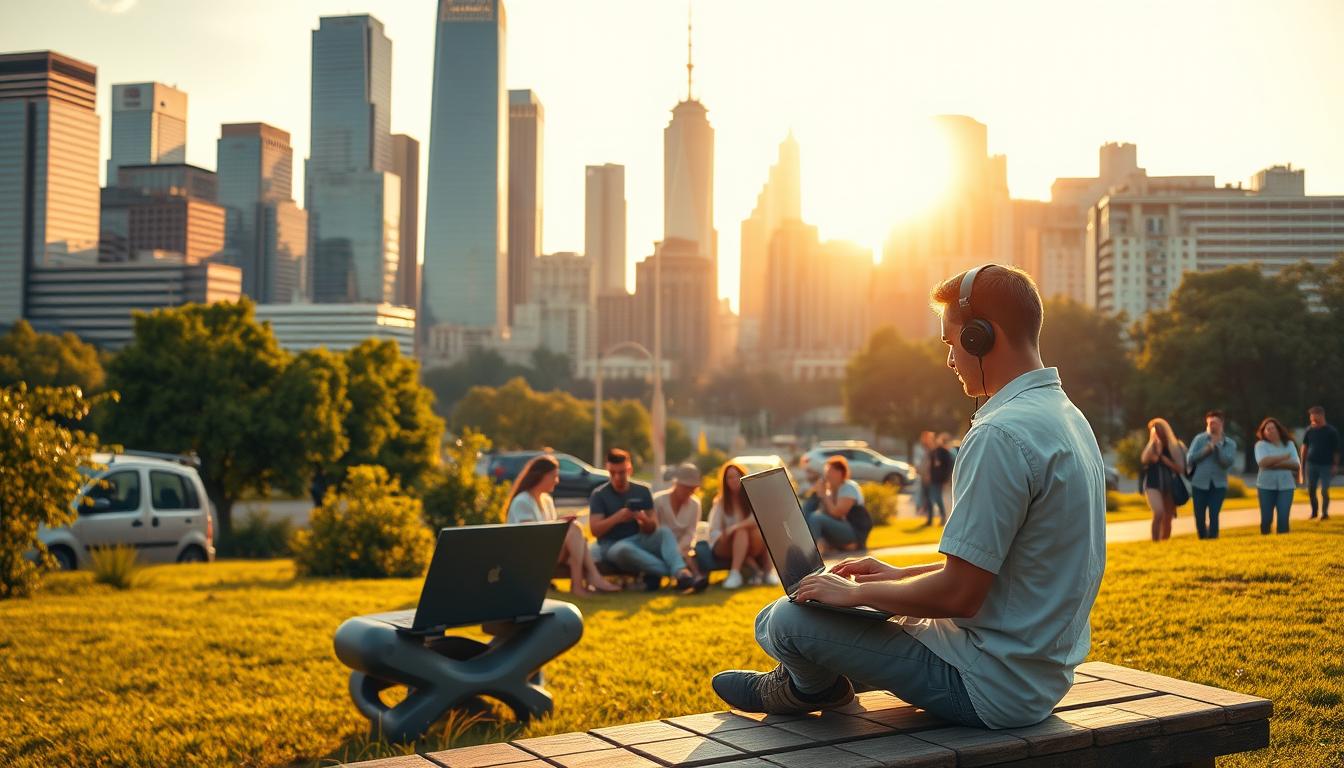
Discover the best eco-friendly hotspots for digital nomads in Singapore — from Gardens by the Bay to park-side coworking spaces. Your 2026 green workspace guide.
Almost nowhere on Earth compresses ambition and greenery into such a small footprint. Singapore — 728 square kilometres of equatorial city-state — now dedicates over 40% of its land to green cover, a figure that rises to nearly 48% when vertical and skyrise greenery is folded into the accounting, according to the World Economic Forum. For the growing tribe of digital nomads in Singapore — professionals who trade fixed desks for location freedom and measure a city by its fibre speed, cost index, and quality of life — this extraordinary statistic is not just an environmental footnote. It is, increasingly, a core reason to come.
The global remote-work revolution has entered a more discriminating phase. Nomads who spent 2020 through 2022 scrambling for any reliable Wi-Fi signal have graduated into preferences for cities that offer what researchers now call “biophilic productivity” — the measurable cognitive and creative lift that comes from working near nature. Singapore’s City in Nature vision, launched as a pillar of the Singapore Green Plan 2030, arrives at precisely the right moment to capture this preference. The plan commits to planting one million trees by 2030, extending 370 kilometres of park connectors, and ensuring every household sits within a ten-minute walk of a park — a standard that most European capitals quietly envy.
What follows is not a listicle. It is an analytical guide to the hotspots where environment, infrastructure, and nomadic ambition converge most productively — and why Singapore’s green bet may be the most underrated competitive advantage in the global talent war.
Why Environment Matters to Digital Nomads in Singapore Now
The economics are straightforward, even if the conversation rarely frames them that way. A 2023 study conducted in collaboration with the NParks Saw Swee Hock School of Public Health partnership found that participants who visited parks during the day reported measurably lower stress levels by evening compared to those who did not. For a nomad on a deadline, lower cortisol is not a wellness cliché — it is an output multiplier.
Singapore’s competitive proposition compounds this wellness dividend with hard infrastructure. The city-state consistently ranks in the top tier globally for internet speed, public transport efficiency, and political stability. Add 7,800 hectares of safeguarded green space, 193 hectares of skyrise greenery already implemented across building facades and rooftop gardens, and a government targeting net-zero emissions around 2045, and you have a location that lets a nomad optimize simultaneously for productivity, sustainability ethics, and personal well-being.
The digital nomad community itself is taking notice. Reviews on Nomad List highlight Singapore’s “well-maintained green spaces” as a top-tier amenity alongside its airport and connectivity — a combination few cities in Asia can match.
Singapore does not yet offer a dedicated digital nomad visa, but the policy landscape is evolving in ways that matter. The Overseas Networks & Expertise (ONE) Pass — a five-year personalised work pass tied to the individual rather than an employer — allows high-earning global professionals to work across multiple companies simultaneously, making it the closest instrument to a nomad-friendly visa the government currently offers. In March 2026, Singapore announced the forthcoming ONE Pass (AI and Tech), launching January 2027, targeting pinnacle talent in artificial intelligence and advanced technology. For nomads who clear the S$30,000 monthly salary threshold, these instruments transform Singapore from a tourist transit into a legal long-term base.
The Top Eco-Hotspots for Digital Nomads in Singapore
1. Marina Bay & Gardens by the Bay — The Iconic Green Nerve Centre
No conversation about eco hotspots for digital nomads in Singapore begins anywhere else. The Marina Bay district fuses Singapore’s financial core with one of the world’s most ambitious urban nature projects: Gardens by the Bay, a 101-hectare nature park built on reclaimed land and anchored by 18 steel Supertrees draped in living ferns, bromeliads, and orchids. At golden hour, the Supertrees become vertical gardens glowing with photovoltaic panels — a fitting visual metaphor for Singapore’s energy-meets-nature strategy.
For nomads, Marina Bay is practical as much as it is photogenic. The precinct hosts multiple premium coworking options within walking distance of the waterfront gardens. JustCo Marina Square offers hot desks and meeting rooms positioned ideally for professionals who want to break for a lakeside walk between calls. The Work Boulevard at Collyer Quay serves sea views alongside its café counter, staffed by Common Man Coffee Roasters, one of Singapore’s finest specialty roasters.
Working here means stepping outside for a lunch break and finding yourself among 1.5 million plants from more than 500,000 species. Research consistently links this kind of biodiversity exposure to restored attention and reduced decision fatigue — a documented phenomenon that neuroscientists term Attention Restoration Theory.
Nomad cost index (monthly estimate): Coworking hot desk from SGD 280–450 / Hawker lunch from SGD 4–6 / Accommodation nearby from SGD 2,800+
2. Bishan-Ang Mo Kio Park — The Naturalized River Corridor
If Marina Bay is Singapore’s showpiece, Bishan-Ang Mo Kio Park is its proof of concept. Here, a concrete canal was transformed into a winding, naturalized river under the PUB’s Active, Beautiful, Clean Waters programme — one of 57 ABC Waters projects now completed across the island. The result is a 62-hectare stretch of ecological corridor connecting heartland neighbourhoods to parkland, biodiversity, and calm.
The adjacent Bishan neighbourhood has emerged as a quieter alternative base for nomads priced out of the CBD, with reliable MRT access and a growing cluster of café-workspaces. The park itself lacks formal coworking infrastructure, but this is precisely its value: the ability to walk twenty minutes along the restored riverbank before returning to a neighbourhood café for a focused deep-work session is the kind of operational rhythm that makes nomad burnout far less likely.
NParks has identified Bishan-Ang Mo Kio as one of 15 sites targeted for contemplative landscape enhancements, using science-based design to improve visitors’ mental well-being. Therapeutic horticulture nodes are being extended into the precinct — a policy move with direct implications for the sustained cognitive output of anyone using it as a working environment.
Nomad cost index (monthly estimate): Neighbourhood coworking from SGD 180–300 / Café Wi-Fi options abundant / Accommodation from SGD 1,600
3. Dempsey Hill & the Botanic Gardens Precinct — Heritage Green for Productive Minds
Tucked between the colonial bungalows of Tanglin and the UNESCO World Heritage-listed Singapore Botanic Gardens, the Dempsey Hill precinct occupies a category of its own: the kind of leafy, unhurried environment that global nomads typically fly to Bali to find, available here with first-world healthcare and world-class connectivity a taxi ride away.
The Singapore Botanic Gardens — 74 hectares of rainforest heritage, orchid collections, and canopied walking paths — is the city’s oldest green lung and a direct resource for any nomad structuring their day around the circadian rhythms of light and movement that support sustained cognitive performance. Early morning sessions in the National Orchid Garden, followed by a working lunch at one of Dempsey Hill’s established restaurants or the restored black-and-white bungalow cafés, make for one of the city’s most civilised daily rhythms.
Coworking infrastructure is lighter here, by design. The appeal is residential: nomads staying in the Tanglin, Buona Vista, or Holland Village belts enjoy proximity to this green corridor while tapping the broader island coworking network via MRT.
Nomad cost index (monthly estimate): Botanic Gardens entry free / Accommodation in Holland Village from SGD 1,800 / Nearest coworking clusters in one-Nord, ~10 min by MRT
4. one-North — The Science-Tech Eco-District
One-North is the rare urban district that was master-planned for both scientific innovation and liveable greenery simultaneously. Developed by JTC Corporation and the Urban Redevelopment Authority, it houses biotech firms, media companies, and research institutes within a low-rise, tree-lined streetscape that feels almost campus-like by Singapore standards.
For tech nomads and startup founders — the primary audience for Singapore’s ONE Pass and Tech.Pass instruments — one-North is arguably the most strategically positioned eco-hotspot on the island. The Biopolis and Fusionopolis clusters are surrounded by enhanced tree canopy, roof gardens, and connectivity to the Southern Ridges trail network. Coworking options, including multiple flexible office operators, cluster in the precinct’s commercial zones.
The district also exemplifies what URA calls “multi-functional green spaces” — integration of biodiversity habitats directly into the built research environment, not as decorative afterthought but as measurable productivity and retention infrastructure. Several corporate tenants have used one-North’s biophilic credentials as a recruiting argument, a practice that independent nomads can effectively replicate in their own workspace choices.
Nomad cost index (monthly estimate): Coworking hot desks from SGD 200–380 / MRT-accessible / Accommodation from SGD 1,700 in nearby Buona Vista
5. Joo Chiat / Katong — The East Coast Green-Cultural Corridor
The east side of Singapore offers a different proposition: cultural texture, lower cost, and a park-connector network that links Joo Chiat’s Peranakan shophouse streets to East Coast Park, a 15-kilometre linear green belt running along Singapore’s southeastern shoreline.
For nomads who define “environment” as broadly as the city’s own City in Nature vision does — encompassing heritage conservation, ecological corridors, and human well-being together — Joo Chiat represents Singapore’s most liveable value proposition. Crane Joo Chiat, a celebrated coworking space inside a renovated shophouse, is described by the nomad community as offering a “café-style vibe with lush greenery, high ceilings, and a calendar full of wellness events and creative workshops,” making it among the most intentionally biophilic workspaces on the island.
East Coast Park’s 185 hectares of shoreline casuarina groves, cycling paths, and beach nodes provide the evening decompression infrastructure that Marina Bay cannot. Many nomads base themselves here precisely because the cost of living drops, the pace slows, and the access to coastal nature compensates for the longer MRT ride into the CBD when necessary.
Nomad cost index (monthly estimate): Crane Joo Chiat coworking from SGD 150–280 / Hawker centres highly accessible / Accommodation from SGD 1,500
Hotspot Comparison Table
| Location | Green Score (1–5) | Coworking Access | Nomad Cost Index (SGD/month) | Sustainability Rating |
|---|---|---|---|---|
| Marina Bay / Gardens by the Bay | ★★★★★ | Excellent (JustCo, WeWork, Work Boulevard) | High (2,800+) | Platinum |
| Bishan-Ang Mo Kio Park | ★★★★☆ | Moderate (neighbourhood cafés) | Mid (1,600–2,200) | Gold |
| Dempsey / Botanic Gardens | ★★★★★ | Light (nearby Holland V. & one-North) | Mid-High (1,800–2,600) | Platinum |
| one-North | ★★★★☆ | Excellent (multiple operators) | Mid (1,700–2,400) | Gold |
| Joo Chiat / East Coast | ★★★★☆ | Good (Crane, café network) | Budget-Mid (1,500–2,000) | Gold |
Green Score based on proximity to NParks-designated green spaces, park connectors, and skyrise greenery density. Cost Index reflects estimated monthly housing + workspace costs.
The Economic ROI of Green Infrastructure for Nomads
The conventional nomad cost analysis counts rent, coworking memberships, and SIM cards. It rarely prices the most expensive input of all: cognitive depreciation from urban stress.
Singapore’s green investment thesis has an ROI that extends well beyond tourism branding. NParks data indicates that skyrise greenery reduces interior building temperatures by up to 3°C — directly cutting air-conditioning energy costs in coworking spaces and improving thermal comfort for workers. The World Economic Forum notes that Singapore’s 48% green coverage “promotes biodiversity, combats urban heat island effects and absorbs rainwater,” providing the kind of climate resilience that makes outdoor working viable year-round in ways that Bangkok or Jakarta cannot consistently offer.
For a nomad calculating a three-month stay, the hidden premium of Singapore’s green infrastructure manifests as fewer sick days (urban biodiversity correlates with lower ambient pathogen loads), lower gym costs (the 370km park connector network is the world’s longest urban cycling and walking network of its kind), and higher creative output — the biophilic productivity dividend referenced above.
The city’s digital economy contributes S$113 billion (17.7%) to GDP, growing at nearly twice the rate of the overall economy. This is the talent pool and knowledge network a nomad enters when they base in Singapore — a pool that the government is actively deepening with the forthcoming ONE Pass (AI and Tech) track launching January 2027. The economics, in short, reward nomads who think of Singapore not as expensive but as high-yield.
Policy Context: No Nomad Visa, But an Evolving Framework
Singapore has no dedicated digital nomad visa in 2026. This is not an oversight; it reflects the government’s preference for high-quality talent flows over volume-based tourism-work hybrids. The ecosystem it has built instead is arguably more valuable to the serious remote professional: world-class healthcare, the ONE Pass for top earners, the EntrePass for entrepreneurs, and a 30-to-90-day visa-free stay for citizens of most OECD countries that allows short-to-medium-term nomadic residency for those working for non-Singapore employers.
The Fragomen APAC analysis notes that while neighbors including Malaysia, Indonesia, and Thailand have launched formal digital nomad visa programs, Singapore continues to differentiate on talent quality rather than volume — a deliberate strategic choice. The announcement of the ONE Pass (AI and Tech) in March 2026, which will allow top global AI professionals to build, operate, and multiply ventures in Singapore over a renewable five-year horizon, signals that this strategy is intensifying rather than softening.
For the nomad community, this means Singapore rewards patience and ambition: come for a short stay under visa-free entry, demonstrate your calibre, and you may find the island offering pathways to something more permanent than most nomad destinations can.
The 2030 Outlook: Singapore’s Green Edge Gets Sharper
By 2030, Singapore has committed to targets that will further compound its eco-advantage for remote workers. Every household will sit within a ten-minute walk of a park. Thirty therapeutic gardens will be operational across the island — scientifically designed landscapes proven to reduce ADHD symptoms, lower cortisol, and restore directed attention. The OneMillionTrees movement will have completed its canopy target, adding more than half a million trees already planted since 2020, with the remainder concentrating on industrial corridors and transit nodes.
URA’s draft Master Plan envisions new ecological corridors like the Kranji Nature Corridor connecting the Central Catchment Nature Reserve to coastal mangroves, and a proposed second marine park at Lazarus South — expanding the city’s blue-green network in ways that will make outdoor working environments more diverse and accessible than they already are.
Meanwhile, the coworking sector is evolving in parallel. The biophilic workspace movement — exemplified globally by buildings like Jewel Changi and locally by the green-certified interiors emerging across the CBD — is converging with Singapore’s urban greening agenda. Expect the next generation of coworking spaces here to compete not on coffee quality alone, but on biodiversity integration, therapeutic landscape design, and verified sustainability credentials. The nomads who arrive today will find themselves in the early innings of this transformation.
The City in Nature model is more than an environmental programme. It is a talent strategy — a proof that liveable, productive, sustainable environments attract and retain the knowledge workers that twenty-first-century economies run on. Digital nomads in Singapore, perhaps more than any other category of worker, are positioned to extract the full compound return on everything that strategy has built.
Singapore is waiting. The Supertrees are glowing. Bring your laptop.