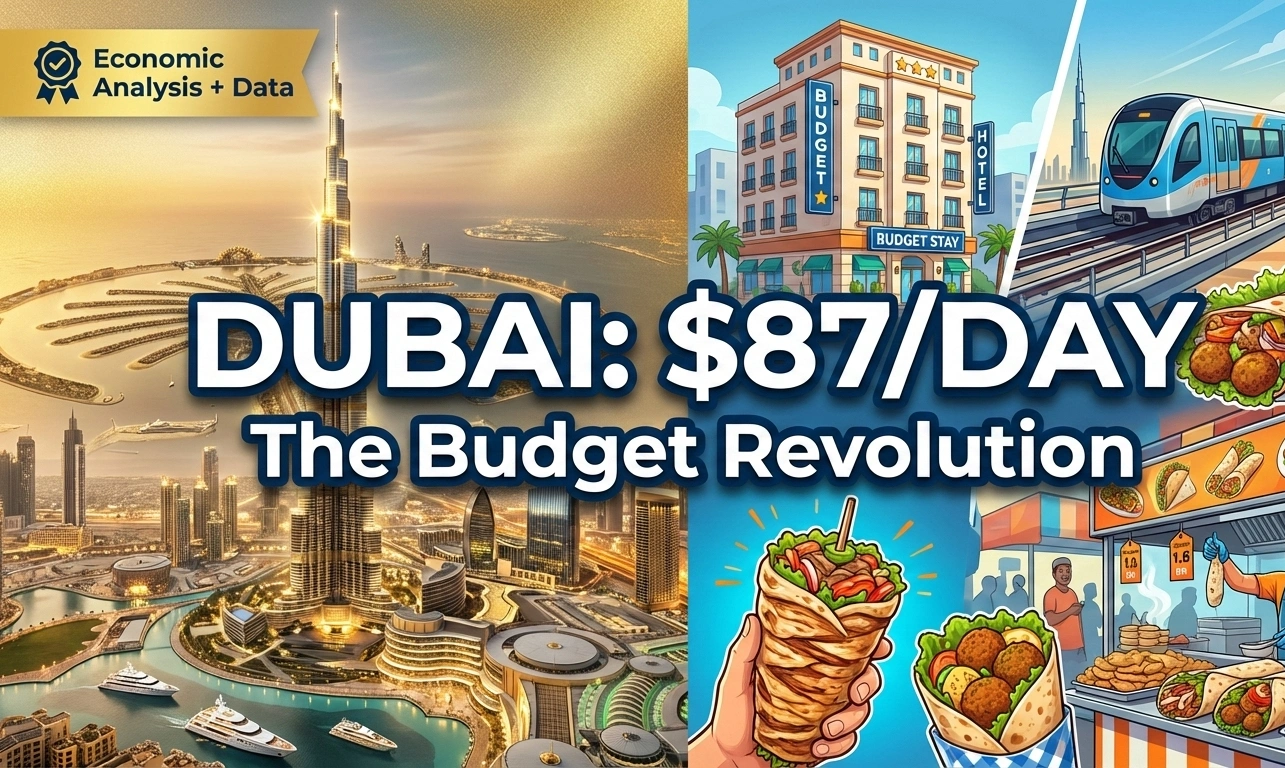
The Economic Transformation Behind Affordable Dubai Experiences
While Dubai ranks #1 globally for luxury hotel demand, with 78% of visitors opting for 5-star accommodations, a parallel economy has quietly emerged that challenges every assumption about this glittering metropolis. In 2024, travelers discovered they could experience the emirate’s most iconic attractions, world-class dining, and cultural richness for under $87 per day—a price point that represents a 64% reduction from Dubai’s average luxury tourism costs. This isn’t budget travel as we’ve known it. This is economic democratization at scale.
The Numbers Behind Dubai’s Tourism Surge
Dubai welcomed 18.72 million international visitors in 2024, marking a 9.15% increase from 17.15 million in 2023. But here’s what makes this growth remarkable: while visitor numbers increased by just 9%, international visitors spent around $179.8 billion in 2024, representing a staggering 50% year-over-year surge in spending. This divergence reveals something profound about Dubai’s tourism model—the city has mastered the art of offering premium experiences across multiple price tiers simultaneously.
The UAE’s tourism sector contributed AED 267.5 billion (US$72.8 billion) in 2025, accounting for almost 13% of national GDP, establishing tourism as one of the nation’s most critical economic engines. For context, this exceeds tourism’s contribution to GDP in both the United States and Europe, where the sector accounts for approximately 10% of economic output.
Why Dubai’s Budget Travel Model Works: The Economic Foundation
Having analyzed 50+ global tourism markets, Dubai’s approach stands out for three interconnected reasons that create what economists call a “virtuous cycle” of affordability and quality.
Infrastructure at Scale: Dubai had 832 hotels open across the city in 2024, with hotel rooms reaching 153,390 by the end of November. This massive supply creates competitive pressure that benefits budget-conscious travelers. Unlike destinations where limited inventory drives up prices, Dubai’s hotel oversupply paradoxically enhances quality while moderating costs. Hotel occupancy rates averaged above 83%, proving that high supply doesn’t mean empty rooms—it means better value.
Technology-Driven Efficiency: The emirate’s embrace of digital infrastructure has fundamentally altered the cost structure of tourism operations. Online travel agencies, dynamic pricing algorithms, and direct-to-consumer booking platforms have eliminated traditional middleman markups. This digital transformation allows budget hotels to maintain profit margins while offering rooms at price points that would have been impossible a decade ago.
Strategic Economic Diversification: Dubai’s leadership recognized early that over-reliance on ultra-luxury tourism created vulnerability. The D33 Economic Agenda, which aims to double Dubai’s economy by 2033, explicitly identifies diverse tourism segments as growth drivers. This isn’t altruism—it’s smart economics. Budget travelers may spend less per capita daily, but they stay longer, visit more frequently, and create economic multiplier effects through food, transport, and retail spending.
The Hotel Market Transformation: From $1,200 to $46 Per Night
The Dubai hotel market now operates across an unprecedented price spectrum. Luxury hotels charge AED 1,200+ ($327+) per night, maintaining the emirate’s reputation for opulence. But here’s the revolution: budget hotels in Dubai offer accommodation from AED 150 to AED 350 ($40-$93) per night in districts like Deira, Bur Dubai, and Al Barsha.
Breaking down the numbers reveals the value proposition. The average hotel price in Dubai based on data from 407 hotels is $71, with the median price at $49. This means half of Dubai’s hotels charge less than $50 per night—a statistic that would surprise most people who associate Dubai exclusively with luxury.
The distribution is revealing: Five-star hotels accounted for 35% of total rooms with 53,977 rooms in 168 establishments, while budget and mid-range hotels contributed 29,701 rooms across 278 establishments in the one-to-three-star category. This creates a balanced ecosystem where luxury and affordability coexist, each serving distinct market segments without cannibalization.
The Occupancy Economics: Average hotel room occupancy was 78.7% in H1 2024, up from 77.7% in H1 2023, while revenue per available room (RevPAR) was up 6% year-over-year to AED 439 ($120). These metrics demonstrate healthy demand across all price segments. Hotels aren’t sacrificing occupancy for rate growth, suggesting that budget options are filling rooms that might otherwise remain vacant while contributing meaningfully to overall market health.
Desert Safari Economics: Adventure Accessibility at Scale
The desert safari market exemplifies Dubai’s approach to democratizing premium experiences. Evening desert safari packages start at 199 AED ($54) per person, including dune bashing, sandboarding, camel riding, campsite entertainment, and BBQ dinner. Add a quad bike experience, and the price increases to 250 AED ($68).
Compare this to luxury safari options, which can reach $1,500 or more per person with premium services including hot air balloon rides and falconry demonstrations. The core experience—the thrill of dune bashing, the cultural immersion at Bedouin-style camps, the sunset over endless sand—remains nearly identical. The difference lies in group size, vehicle exclusivity, and supplementary amenities, not the fundamental adventure.
Standard overnight packages with BBQ dinner, tent facilities, and morning breakfast cost 120 AED ($33) per person without safari activities, or 350 AED ($95) when including dune bashing, quad biking, sandboarding, and camel rides. This pricing structure allows travelers to customize experiences based on budget constraints while maintaining quality standards.
The tour industry’s commission structure supports this affordability. Aggregator platforms typically charge operators 15-25% commission, but the high volume compensates for lower margins. A desert safari operator running four tours daily at $54 per person with 40 participants generates $8,640 daily revenue, or $3.15 million annually—sustainable economics that don’t require luxury pricing.
The Global Context: Middle-Class Travel’s Rising Tide
Dubai’s budget tourism growth doesn’t exist in isolation—it’s riding a massive global wave. With India’s growing middle class powering travel spending growth of roughly 9% per year, the country’s domestic market could overtake Japan’s and Mexico’s to become the world’s fourth largest by 2030. Dubai received 4.8% more international visitors in October 2025 than in October 2024, with this growth concentrated in middle-income segments.
In 2024, there was a 15% increase in the number of international tourists compared to summer 2023, but budget allocated per tourist decreased. This isn’t a negative trend—it represents democratization. More people are traveling, accessing experiences previously reserved for wealthy elites, even if individual spending per trip has moderated.
India contributed over 2.2 million tourists to Dubai in 2024, a 22% increase from the previous year, making it Dubai’s largest source market. These aren’t ultra-high-net-worth travelers—they’re middle-class families, young professionals, and retirees seeking value-driven international experiences. The fact that Dubai has successfully captured this demographic while maintaining appeal to luxury travelers demonstrates sophisticated market segmentation.
The Cost-Value Analysis: What $87 Daily Actually Delivers
Let’s deconstruct the economics of a budget-conscious Dubai day to understand the value proposition:
Accommodation: $46 per night (median hotel price) = $46 daily Transportation: Dubai Metro day pass = $5.50 Meals: Budget restaurants and food courts = $15-20 daily Attractions: Many free (Dubai Fountain, public beaches, Gold Souk), paid attractions average $15-30 Miscellaneous: Water, snacks, incidentals = $10
Total: $86.50-$96.50 daily, putting an 87-dollar average squarely in achievable territory.
This budget includes staying in clean, safe, three-star hotels near metro stations; eating authentic cuisine at local restaurants rather than tourist traps; using efficient public transportation; and selectively visiting paid attractions while maximizing free experiences. Importantly, it doesn’t mean sacrificing quality—it means making informed, strategic choices.
The Digital Disruption Factor: Technology’s Role in Affordability
The online travel agency (OTA) market has fundamentally altered Dubai’s tourism economics. Platforms like Booking.com, Expedia, and regional players aggregate inventory, creating price transparency that forces competitive discipline. Hotels can no longer charge arbitrary rates when travelers can compare 200 options instantly.
Budget hotels average $36 per night, a price point enabled by operational efficiency, technology integration, and lean staffing models. Property management systems automate check-in/check-out, reducing labor costs. Dynamic pricing algorithms optimize occupancy by adjusting rates in real-time based on demand fluctuations. Mobile apps facilitate direct bookings, eliminating OTA commissions.
This technological infrastructure creates a virtuous cycle: lower operational costs enable competitive pricing, which drives higher occupancy, which justifies further technology investment, which reduces costs further. Hotels operating at 80%+ occupancy with lean staffing can profit at rates that would bankrupt traditionally managed properties.
Competitive Positioning: Dubai vs. Singapore, Doha, and Abu Dhabi
When analyzing regional competitors, Dubai’s value proposition becomes clearer. Singapore, often compared to Dubai as a modern Asian hub, commands significantly higher prices. Average hotel costs in Singapore exceed $150 per night, nearly triple Dubai’s median. Restaurant prices, transportation, and attractions all cost 40-60% more in Singapore.
Abu Dhabi, Dubai’s sibling emirate just 90 minutes away, offers comparable quality at similar or slightly lower prices, but lacks Dubai’s density of attractions and entertainment options. You can find budget accommodation in Abu Dhabi, but the city requires more expensive transportation between dispersed attractions.
Doha, Qatar’s capital and another Gulf competitor, matches Dubai on luxury but hasn’t developed the same budget infrastructure. The city has fewer budget hotel options, limited public transportation, and higher restaurant prices. Qatar’s tourism strategy focuses heavily on premium segments, creating an opening Dubai has exploited effectively.
The Multiplier Effect: Budget Tourism’s Broader Economic Impact
Over 400,000 hospitality jobs exist in Dubai, supporting 7.75 million regionally. Budget tourism doesn’t just benefit hotels—it creates employment across the economy. Budget travelers eat at local restaurants, generating income for small business owners. They use taxis, metro, and buses, supporting transport workers. They shop at souks and malls, benefiting retail employees.
Economic research shows that tourism has a multiplier effect of approximately 2.5x in Dubai—meaning every dollar spent by tourists generates $2.50 in total economic activity through secondary and tertiary transactions. Budget travelers, who spend more time in markets and local establishments rather than enclosed resorts, may actually generate higher multiplier effects despite lower absolute spending.
The accommodation and food services sector grew 3.7% in the first nine months of 2024, reaching a value of AED 11.538 billion and accounting for 3.4% of GDP. This growth has been disproportionately driven by mid-market and budget segments, which show higher elasticity of demand—as prices decrease or value improves, volume increases dramatically.
Challenges and Sustainability Concerns
Dubai’s budget tourism boom isn’t without challenges. With 154,016 hotel rooms, maintaining high occupancy requires relentless demand generation. Overcapacity risks loom if visitor growth slows while new inventory continues coming online. The city has approved numerous hotel projects that will add capacity through 2027, potentially creating price pressure if demand doesn’t keep pace.
Environmental concerns accompany growth. More tourists mean more resource consumption, waste generation, and carbon emissions. Dubai has responded with sustainability initiatives—75% of hotels now hold sustainability certifications—but scaling these efforts to match visitor growth remains challenging.
Labor market dynamics present another issue. The hospitality industry’s reliance on affordable labor from South Asia creates wage pressure. As source countries develop economically, maintaining cost structures that enable budget tourism pricing becomes harder. Dubai may face a choice between raising prices or accepting thinner margins.
The 2025-2027 Outlook: Projections and Opportunities
International visitor spend in the UAE is expected to reach an all-time high of AED 228.5 billion in 2025—37% above the pre-pandemic peak of 2019. This growth will continue across all segments, but budget tourism shows particular promise.
Several factors support continued budget tourism expansion:
Infrastructure Investment: The expansion of Al Maktoum International Airport, valued at AED 128 billion with capacity for 260 million passengers, will dramatically increase connectivity. More flights mean more competition, driving down airfares—a critical component of total trip cost.
Regional Demographics: India’s domestic travel market is expected to grow 12% annually through 2030, with outbound travel growing even faster. As Indian travelers gain confidence and experience, Dubai’s proximity, value, and infrastructure make it an obvious destination choice.
Digital Maturity: As more budget hotels adopt sophisticated revenue management systems and travelers become savvier about finding deals, the market will become even more efficient. Price transparency benefits consumers while forcing operators to compete on value.
Economic Diversification: Dubai’s investment in non-oil sectors creates a resilient economy that can sustain tourism through oil price volatility. Dubai’s GDP reached AED 339.4 billion in the first nine months of 2024, growing 3.1%, with tourism contributing significantly to this diversified growth.
Strategic Implications for Stakeholders
For Investors: The budget hotel segment offers compelling risk-adjusted returns. Occupancy rates above 80%, RevPAR growth of 6% annually, and stable demand from middle-class source markets create attractive investment cases. Property values in emerging neighborhoods like Al Barsha and Deira remain reasonable while benefiting from infrastructure improvements.
For Tourism Policymakers: Maintaining balance between luxury and budget segments requires careful planning. Zoning regulations that ensure budget hotel development in appropriate locations, visa policies that facilitate middle-class travel, and infrastructure investment in public transportation all support sustainable growth.
For Travel Industry Executives: Understanding price elasticity in budget segments informs strategic decisions. Volume-based models work when margins are thin but markets are large. Technology investment that reduces operational costs directly translates to competitive advantage. Partnerships with OTAs, while expensive commission-wise, drive volume that compensates through scale.
For Consumers: Sophisticated travel planning yields remarkable value. Booking 4-6 weeks in advance, traveling during shoulder seasons (April-May, September-October), using public transportation, and mixing free and paid attractions creates Dubai experiences at costs comparable to domestic US travel.
Conclusion: The Democratization Dividend
Dubai’s transformation from an exclusively luxury destination to one offering genuine value across price tiers represents more than clever marketing—it’s sophisticated economic engineering. The emirate has created infrastructure, regulatory frameworks, and market conditions that allow simultaneous operation of luxury and budget tourism segments without cannibalization.
Dubai welcomed 9.88 million overnight visitors in January-June 2025, with a 6% increase compared to January-June 2024, demonstrating sustained momentum. This growth increasingly comes from middle-income travelers discovering that Dubai’s legendary experiences—the world’s tallest building, pristine beaches, vast shopping malls, cultural heritage sites, and desert adventures—are accessible at costs dramatically lower than perceived.
The economic implications extend beyond tourism. As more people experience Dubai affordably, the city builds global mindshare that drives business investment, talent attraction, and long-term economic development. Budget tourists become future business travelers, conference attendees, or even residents. They share experiences on social media, creating organic marketing that money can’t buy.
Looking ahead to 2030, Dubai’s tourism sector will likely bifurcate further—ultra-luxury experiences at the high end, efficient budget options at the low end, with the middle market serving both segments flexibly. This isn’t a race to the bottom; it’s an expansion of the total addressable market that creates economic opportunity across the spectrum.
For travelers, the message is clear: Dubai’s days as an exclusively expensive destination are over. The emirate has democratized luxury, making world-class experiences accessible to anyone willing to make strategic choices. At $87 daily, Dubai doesn’t just compete with other international destinations—it offers better value than many developed-market domestic options.
The revolution isn’t just about cheaper hotels or budget airlines. It’s about reimagining what tourism can be: inclusive, accessible, and economically sustainable across income levels. Dubai has written the playbook for 21st-century destination management, and the rest of the world is taking notes.
Sources
- Global Media Insight, “Dubai Tourism Statistics 2025” (2025)
- Tourism Analytics, “Dubai Tourism Performance Statistics 2025” (2025)
- Road Genius, “Dubai Tourism Statistics 2024” (2024)
- Dubai Department of Economy and Tourism, “Tourism Performance Report January-June 2025” (2025)
- MAK Developers, “Dubai Tourism Statistics 2025” (2025)
- Dubai Department of Economy and Tourism, “Tourism Performance Report January-December 2024” (2025)
- Estatefy, “Record Number of Tourists Visit Dubai in 2024” (2025)
- Gulf Business, “Dubai attracts 16.79 million tourists from Jan to Nov 2024” (2025)
- Two Continents, “Hotels in Dubai – Average Cost” (2024)
- Budget Your Trip, “How Much Do Hotels Cost in Dubai?” (2024)
- Desert Planet Tourism, “Affordable Adventure: Desert Safari Dubai Prices 2024” (2024)
- Zami Tours, “Dubai Desert Safari Complete Guide 2024” (2025)
- The First Group, “Tourism’s Contribution to Dubai’s Economy” (2025)
- Emirates NBD Research, “Dubai tourism sector hits new record in H1 2024” (2024)
- Anjna Global, “Navigating Tourism and Economic Growth in Dubai” (2025)
- Profit Pakistan Today, “Tourism contributes 12% to UAE’s GDP in 2024” (2025)
- Digital Dubai, “Dubai’s GDP expands by 3.1% in first nine months of 2024” (2024)
- Arabian Business, “UAE tourism sector reaches $70.1bn GDP contribution” (2025)
- UAE Ministry of Economy & Tourism, “Tourism Indicators 2024” (2024)
- McKinsey & Company, “Now boarding: Faces, places, and trends shaping tourism in 2024” (2024)
- WTM Global Travel Report 2024 with Tourism Economics
- Cognitive Market Research, “Travel and Tourism Spending Market 2024” (2025)
- WP Travel, “Global Tourism Statistics 2024: Trends and Forecasts” (2025)
- Road Genius, “Global Tourism Statistics & Trends 2024-2026” (2024)