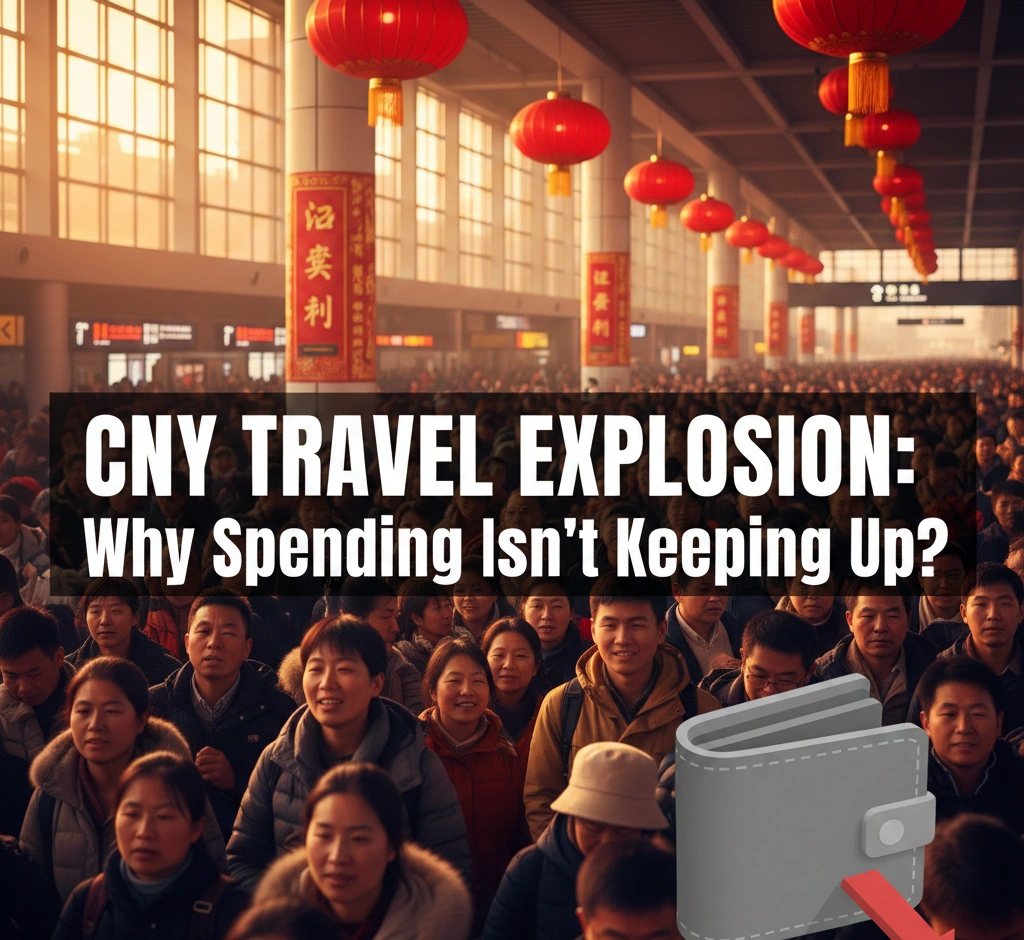
China’s 2026 Spring Festival logged 596 million domestic trips and $116B in tourism spending — but per-capita outlays fell, revealing cautious consumers beneath the record headlines.
At Beijing West Railway Station on the eve of the Year of the Horse, the scene was one of orchestrated chaos: red lanterns swaying above a sea of roller luggage, families hoisting children onto shoulders to navigate the crush, and departure boards flashing a blur of city names — Chengdu, Guangzhou, Harbin, Urumqi. For nine consecutive days beginning February 15, 2026, China essentially got up and moved. What followed was the most expansive Chinese New Year travel rush in recorded history — and a data story that tells two very different tales at once.
The headline numbers are breathtaking. According to the Ministry of Culture and Tourism, 596 million domestic trips were made during the 2026 Spring Festival holiday, an increase of 95 million compared with the eight-day break in 2025. Total domestic tourism spending reached 803.5 billion yuan — approximately $116.3 billion — surpassing the prior year by 126.5 billion yuan. Cross-border movements hit 17.8 million, up 10.1 percent year-on-year, with foreign arrivals into China climbing 21.8 percent on a daily average basis. By virtually every aggregate measure, the Chinese New Year travel surge of 2026 rewrote the record books.
But peel back a layer, and a more complicated portrait emerges. Average spending per trip fell from roughly 169 yuan during the 2025 holiday to approximately 150 yuan — a decline of about 11 percent in per-head outlays, as reported by Caixin Global. Cinema ticket sales — historically one of the Spring Festival’s most reliable consumer barometers — dropped to 120 million attendees, down sharply from a record 187 million in 2025, the steepest single-year decline since 2022. Daily per capita tourism expenditure averaged just 150 yuan, versus 168 yuan the previous year. China’s consumers, it turns out, are showing up in record numbers but spending more carefully once they arrive.
The Surge in Domestic and Cross-Border Travel
The scale of this year’s Spring Festival tourism statistics is almost difficult to contextualize. To put 596 million domestic trips in perspective: that is nearly twice the population of the United States, moving across a country the size of Europe, in nine days. Across the broader 40-day Chunyun travel rush — the world’s largest annual migration — the National Development and Reform Commission projected approximately 9.5 billion total journeys, with self-driving accounting for roughly 80 percent of inter-city movement.
China’s rail network bore enormous weight. CGTN reported that the China State Railway Group handled 121 million passenger trips during the holiday window, a daily average of 13.41 million — up 11.5 percent from last year. On February 23 alone, the system processed a record 18.73 million single-day trips, as millions of workers returned to urban centers after the celebrations wound down. Some 298 million rail tickets were sold through the 12306 platform by mid-morning on the last peak day.
Cross-border travel told an equally dynamic story. China’s National Immigration Administration estimated average daily inbound and outbound flows of 2.05 million travelers — a 14.1 percent jump year-on-year. Among inbound visitors, 1.313 million foreign nationals entered China, with approximately 460,000 taking advantage of the country’s expanded visa-free policies. Caixin noted that Trip.com saw Canadian bookings to China surge 75 percent and UK bookings rise 37 percent following the extension of bilateral visa-free arrangements. Inbound flight bookings from outside China for the Spring Festival period soared more than 400 percent compared with the same holiday in 2025.
Key Travel Statistics: Spring Festival 2026 vs. 2025
| Metric | 2026 | 2025 | Change |
|---|---|---|---|
| Domestic trips | 596 million | 501 million | +95 million (+19%) |
| Total tourism spending | 803.5B yuan ($116.3B) | 677B yuan | +126.5B yuan (+18.7%) |
| Avg. spend per trip | ~150 yuan | ~169 yuan | −19 yuan (−11.2%) |
| Daily per capita spend | 150 yuan | 168 yuan | −10.7% |
| Cross-border trips | 17.8 million | ~16.2 million | +10.1% |
| Foreign arrivals | 1.313 million | ~1.077 million (est.) | +21.8% daily avg. |
| Rail passenger trips | 121 million | ~108 million | +11.5% |
Sources: Ministry of Culture and Tourism; China State Railway Group; National Immigration Administration
Why Per Capita Spending in the Year of the Horse Stayed Stagnant
The gap between soaring trip volumes and flat individual outlays is the central paradox of the 2026 Lunar New Year tourism recovery — and it reflects structural pressures that have shadowed China’s consumer economy for the better part of two years.
China’s GDP growth met its 5 percent annual target in 2025, but the economy decelerated sharply in the fourth quarter to its weakest pace since early 2023, as The Star reported. Real estate remains a drag on household wealth. Youth unemployment, while improved from its 2023 peak, continues to suppress discretionary confidence among the 18–35 demographic. And deflation — or at best disinflation — means consumers have grown accustomed to downward price pressure, making them reluctant to commit to full-price leisure spending.
The result is a behavioral pattern economists describe as “volume substitution”: consumers travel more frequently and to more destinations, but they trade down on accommodation, dining, and entertainment to manage their overall budgets. Rather than stay in a four-star hotel in Shanghai, a family might book a guesthouse in a lower-tier city. Rather than splurge at a sit-down restaurant, they opt for street food and local markets. Tongcheng Travel noted that nearly 40 percent of outbound tourists this Spring Festival originated from non-first-tier cities, reflecting expanding participation from lower-income brackets — a demographic that broadens travel volumes but compresses average ticket sizes.
The box office decline is perhaps the starkest illustration. In 2025, the theatrical release of Ne Zha 2 produced a cinematic phenomenon, propelling attendance to 187 million. Without a comparable blockbuster in 2026, The Star reported that total Spring Festival cinema attendance dropped to 120 million — a 35.8 percent fall. Box office revenue totaled approximately 5 to 6 billion yuan, well below the prior year’s record. The absence of a cultural event capable of commanding premium pricing across demographics highlights how sensitive per capita spending is to what economists call “anchor experiences.”
Erica Tay, director of macro research at Maybank, offered a measured read of the data: momentum in China’s first quarter of 2026 “may turn out less sluggish than expected,” partly due to a temporary reprieve in U.S.-China trade tensions, which has incentivized Chinese exporters to front-load shipments. But she stopped short of declaring a sustained consumer revival. The World Bank forecasts GDP growth of 4.4 percent for 2026; the IMF puts it at 4.5 percent — both below last year’s 5 percent target, suggesting the structural headwinds underpinning cautious holiday spending are not about to vanish.
The Bright Spots: Tech, Silver Tourism, and the Inbound Wave
Against the spending caution, several categories defied the trend with genuine vigor, offering a forward-looking glimpse of where Chinese consumer culture is heading.
Smart technology emerged as a breakout sector. Sales of wearable gadgets surged 19.7 percent during the holiday, with smart glasses more than doubling and AI-enabled health monitors — particularly blood glucose tracking devices — rising nearly 50 percent, CGTN reported. Government trade-in subsidies and targeted consumption incentives helped catalyze these purchases, but underlying demand is structural. China’s tech-savvy middle class increasingly treats health-monitoring devices and AI-integrated tools as essential consumer goods rather than luxury items.
Senior travel staged a remarkable breakout. Modern Diplomacy noted that according to Qunar data, travelers aged 60 and over surged 1.6 times compared with the 2025 Spring Festival. Fully 20 percent of all passengers flying to Beijing during the holiday were over 50. This is not merely a demographic curiosity — it signals the emergence of China’s “silver economy” as a formidable force in domestic tourism, one with both the time and, for many, the savings accumulated across decades of high-growth prosperity. Travel product providers that successfully court this cohort will be positioned for durable growth.
Inbound tourism delivered its most compelling numbers in years. Alibaba’s travel platform Fliggy reported that hotel room nights surged 75 percent year-on-year, while packages combining theme parks and accommodations jumped 140 percent. The visa-waiver expansion — extending free entry to passport holders from Canada, the United Kingdom, and dozens of other nations — is producing measurable behavioral change. British tourists like one documented visitor at Shanghai’s Yuyuan Garden, who described experiencing “the most authentic Chinese New Year,” represent a growing class of inbound traveler: curious, culturally engaged, and primed to spend on experiences rather than souvenirs.
Comparing 2026 to the Post-COVID Rebound Arc
To properly frame this year’s data, it is worth recalling where China’s travel sector stood three years ago. The abrupt end of zero-COVID restrictions in late 2022 produced a chaotic and uneven 2023 Spring Festival recovery. The 2024 holiday, extended to eight days for the first time, generated genuine momentum. In 2025, the Ne Zha 2 phenomenon and a still-intact post-pandemic travel euphoria drove record per-capita engagement.
The 2026 picture represents a maturation phase rather than a continuation of linear recovery. Volume growth is democratizing — more people are traveling, from more cities, to more destinations. But the era of simply releasing pent-up demand has ended. What replaces it is a more complex consumer psychology: a desire for experience and connection, tempered by financial prudence.
Caixin Global’s analysis captured this shift with characteristic precision: “Although more people are traveling, individual outlays have tightened.” This dynamic is not unique to China — post-pandemic travel cycles in Europe and the United States followed similar arcs — but it carries particular significance in Beijing, where policymakers have made boosting household consumption a stated top priority for the second consecutive year.
Implications for China’s Stimulus Strategy and the Road Ahead
The Spring Festival always functions as a stress test for consumer policy — and the 2026 results will feed directly into deliberations at the National People’s Congress Two Sessions, which convene March 4. Policymakers will be parsing the per-trip spending decline alongside the volume surge as they calibrate the scope of additional stimulus measures.
The signals are mixed but not discouraging. Retail and catering enterprises saw average daily sales rise 8.6 percent in the first four days of the holiday compared with 2025, according to the Ministry of Commerce — a solid baseline reading. UnionPay and NetsUnion processed 4.93 billion payment transactions on Chinese New Year’s Eve alone, up 21.64 percent, Xinhua reported — suggesting digital spending infrastructure remains deeply embedded in consumer behavior.
The IMF’s prescription — that China must pivot from an export- and investment-led model toward consumption-driven growth — finds some validation in the Spring Festival data’s directional trends, even if the quantum of per-capita spending falls short of what that transition ultimately requires. Service-oriented consumption is rising. Experience-based travel is expanding. Technology adoption is accelerating. These are the early structural shifts the rebalancing agenda demands.
What the holiday cannot tell us — and what markets will be watching as the Year of the Horse progresses — is whether the consumption enthusiasm of Chunyun proves durable across the remaining ten months of the calendar. History suggests caution. The post-Lunar New Year hangover in consumer activity has been a recurring feature of China’s economic cycle, and 2026 will be no different unless wage growth, property market stabilization, and confidence-bolstering policy measures materially shift household balance sheet psychology.
Conclusion: A Record With an Asterisk
The 2026 Chinese New Year travel season delivered a genuinely historic volume achievement. 596 million domestic trips. $116 billion in tourism spending. 17.8 million cross-border journeys. These are not figures any other nation’s holiday season can match — and they confirm that China’s travel sector has the structural depth and demographic scale to sustain impressive aggregate growth even in headwind conditions.
But the per-trip spending contraction — from 169 yuan to 150 yuan — is the number policymakers and investors should be studying most carefully. It is the economy’s honest signal, transmitted through hundreds of millions of individual spending decisions: Chinese households are willing to invest in togetherness and exploration, but they are doing so with one eye on the exit. Until job security feels more durable, property values stabilize, and wage growth outpaces inflation more convincingly, China’s consumers will keep traveling — and keep counting their yuan once they arrive.
As the lanterns come down and the bullet trains empty out, the Year of the Horse begins its fiscal gallop with cautious optimism as the prevailing mood. The question now is whether Beijing’s policy response — to be outlined at the Two Sessions in March — can convert that caution into something more expansive. China’s tourism industry, and much of the global economy downstream from it, will be watching closely.
Data sources: Ministry of Culture and Tourism; Caixin Global; CGTN; Xinhua; The Star; China’s official government portal; Modern Diplomacy