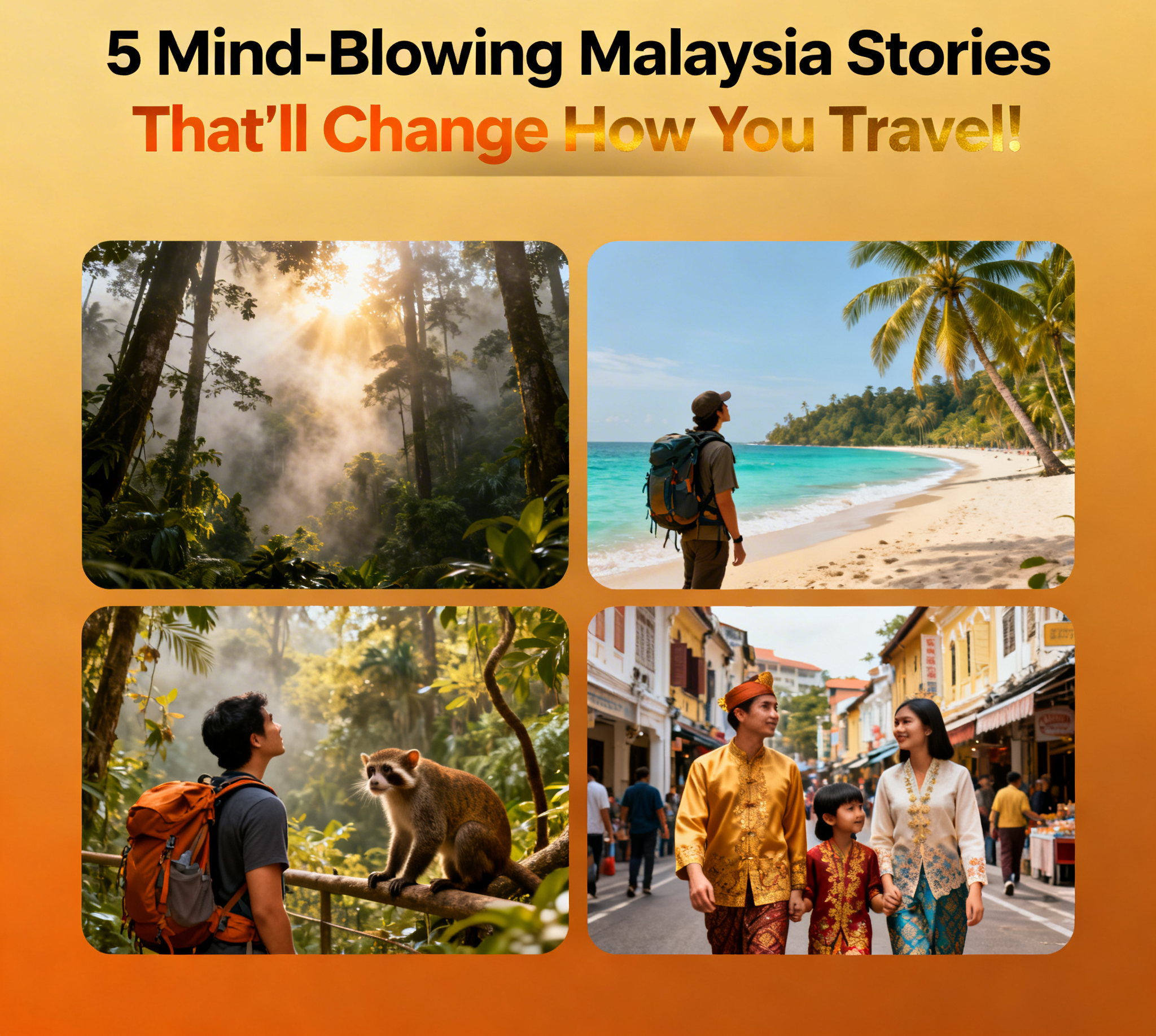
There is a particular kind of magic that descends on travelers the moment they land in Malaysia—a sensory overload of turmeric and lemongrass, call to prayer echoing over colonial shophouses, and the ancient, breathing darkness of a rainforest older than the Amazon. It is no accident that Malaysia welcomed a record 42.2 million international visitors in 2025, an 11.2% surge from the previous year, cementing its position as one of Southeast Asia’s most compelling—and consistently underrated—destinations.
As the Visit Malaysia 2026 campaign pivots toward authentic, experience-led journeys over transactional tourism, a new kind of traveler story is emerging from its archipelagos, jungles, and labyrinthine food streets. These are not the polished narratives of resort brochures. They are real Malaysia travel adventures—gritty, luminous, life-altering—told by the people who lived them. Economists at the Tourism Analytics Unit note that experience-driven travel now generates approximately 34% more per-capita spending than conventional sightseeing tourism in Malaysia, a shift that is reshaping entire communities.
Here are five of the most inspiring Malaysia trips that capture this transformation—and everything you need to plan your own.
1. Jungle Whispers: One Traveler’s Life-Changing Journey Through Borneo’s Ancient Rainforests
Elena Sorokina, a 38-year-old conservation biologist from Prague, had spent two decades reading about Borneo. Nothing prepared her for the silence. “Not actual silence,” she corrects herself, laughing. “But the kind that fills you completely—hornbills overhead, the percussion of rain on Dipterocarp canopy 60 meters up. I wept on the first morning and I cannot entirely explain why.”
Elena joined a community-led ecotourism program in the Danum Valley Conservation Area, a 438-square-kilometre tract of old-growth lowland forest in Sabah, rated by BBC Travel as one of the last great wildernesses accessible to non-scientists. Over nine days, she tracked pygmy elephants with Kadazan Dusun guides, witnessed a Rafflesia in full, brief bloom, and participated in a forest bathing ritual the community calls mandahili—a meditative immersion that, local elders argue, predates modern wellness tourism by centuries.
Why this story matters analytically: Borneo’s wildlife-based tourism corridor contributed an estimated MYR 2.1 billion to Sabah’s GDP in 2025, according to Sabah Tourism Board data, while simultaneously funding anti-poaching patrols across six protected zones. It is a rare case study in tourism as conservation infrastructure.
Planning tips for Borneo adventure experiences:
- Fly into Kota Kinabalu or Tawau, then transfer by road or light aircraft to Lahad Datu for Danum Valley
- Book community homestays through certified operators listed on TripAdvisor’s Sabah Ecotourism hub for vetted, sustainable operators
- Travel between March and October for optimal wildlife sightings; the wet season (November–February) offers dramatic landscapes and fewer crowds
2. The Edible Map of Penang: A Food Writer’s Obsession With George Town’s UNESCO Streets
James Okafor, a Lagos-born food journalist based in London, arrived in Penang intending to write a 1,200-word piece. He stayed for three weeks. “Every corner was a new chapter,” he wrote in his award-shortlisted dispatch. “The char kway teow at the hawker stall on Lorong Selamat—the woman who has been cooking it since 1978—that is not just food. That is compressed history.”
George Town, a UNESCO World Heritage Site since 2008, has become the anchor of what Travel Weekly Asia identifies as Malaysia’s emergent “culinary heritage tourism” sector, which recorded a 22% year-on-year growth in 2025. Penang’s streets offer arguably the highest density of historically significant street food in the world: Hokkien mee, nasi kandar, Nyonya laksa, apom balik. Each dish is a living document of migration—Indian laborers, Hokkien merchants, Malay traders, and British colonizers whose cultural collision produced one of the world’s great fusion cuisines.
James’s story went viral across food media not because of the food alone, but because of the people. Penang’s hawker vendors are aging; the average age of a heritage hawker stall operator is now 67. His reporting sparked a quiet conversation about culinary succession and cultural preservation that Malaysia’s Tourism Ministry has since incorporated into its Visit Malaysia 2026 messaging.
Why this story inspires: It reframes food tourism as an act of cultural rescue—and reminds us that the most profound Malaysia travel experiences are often found at a plastic folding table on a five-foot walkway, not a Michelin-starred room.
Practical advice for Penang travelers:
- Use the Penang Heritage Trail map to navigate both food and architectural landmarks simultaneously
- Arrive at hawker centers before 8:00 AM or after 8:00 PM to avoid peak congestion
- Participate in a Nyonya cooking class through operators recommended by Scott Dunn’s Malaysia experiences for structured culinary immersion
3. Healing Waters: An Executive’s Preventive Healthcare Journey in Langkawi
By 2025, Malaysia had quietly become Southeast Asia’s fastest-growing preventive healthcare tourism destination, with arrivals for wellness and medical purposes increasing 18.4% year-on-year, according to TTG Asia’s tourism intelligence reports. Nowhere exemplifies this more vividly than Langkawi—an archipelago of 99 islands whose geological designation as a UNESCO Global Geopark masks its emergence as a world-class wellness corridor.
Priya Nair, a 45-year-old tech executive from Singapore, spent seven days at a biohacking and Ayurvedic retreat embedded in Langkawi’s mangrove interior. “I came for stress relief,” she told me over a video call. “I left having reframed my relationship with productivity entirely.” Her experience included genomic-based nutritional consultations, forest therapy, and jamu treatments drawing on indigenous Malay herbal traditions that are now being studied in partnership with Universiti Malaya’s pharmacognosy department.
This intersection of ancient wisdom and clinical precision represents what Economist-aligned researchers describe as the “third wave” of health tourism: beyond medical procedures and spa retreats, into integrated preventive protocols that attract high-net-worth travelers willing to spend MYR 15,000–40,000 per week.
Planning tips for Langkawi wellness travel:
- Retreat operators certified under Malaysia’s Medical Tourism Council maintain rigorous international standards; verify credentials via Jacada Travel’s curated wellness portfolio for Southeast Asia
- Combine wellness stays with Langkawi’s extraordinary geopark geology tours for a mind-body-landscape trifecta
- The shoulder seasons of April–May and September–October offer cooler temperatures ideal for outdoor therapies
4. The Spice Merchants’ Descendants: Discovering Melaka’s Living History
Sofia Andrade, a Portuguese documentary filmmaker, came to Melaka chasing a peculiar inheritance: her surname. She suspected—correctly, as it turned out—that she was descended from the Portuguese traders who colonized the port city in 1511, and whose descendants still live in a small enclave called the Portuguese Settlement, speaking a 500-year-old Creole called Kristang.
“I met a woman named Rosa who cooked me a fish curry using a recipe she said came down seventeen generations,” Sofia recalls. “The spices, the technique—some of it identical to what I cook in Lisbon today. History is not always in museums. Sometimes it is in a curry.”
Melaka’s tourism has undergone a remarkable renaissance, with the city receiving recognition from Expedia as one of Asia’s top-emerging heritage destinations in 2025–2026. The city’s tripartite heritage—Malay sultanate, Portuguese colonial, Dutch VOC—creates a layered cultural topography unmatched in Southeast Asia. The Global Meet 2025 event, a major cultural convergence held in the city, brought together heritage tourism operators from 34 countries and generated an estimated MYR 87 million in economic activity over its five-day run.
Why this story resonates: Sofia’s personal Malaysia travel story underscores what data increasingly confirms—that heritage authenticity, not manufactured spectacle, drives the highest traveler satisfaction scores and the strongest word-of-mouth conversion in 2025 tourism markets.
Tips for Melaka’s heritage traveler:
- Stay within the UNESCO core zone for walkable access to Jonker Street, Stadthuys, and the Portuguese Settlement
- Engage a Baba Nyonya cultural guide for context that no audio tour can replicate; operators are listed through Wonderful Malaysia’s official portal
- Visit on weekday evenings when Jonker Night Market transforms the street into one of Asia’s most atmospheric nocturnal bazaars
5. Between the Tides: A Solo Traveler’s Spiritual Reset on the Perhentian Islands
It was a last-minute decision. Marcus Webb, a 29-year-old graphic designer from Manchester who had just left a job he hated, bought a one-way flight to Kuala Terengganu with MYR 3,000 in savings and a secondhand snorkel. “I needed to disappear,” he says. “Malaysia let me.”
The Perhentian Islands—accessible only by speedboat from Kuala Besut—remain one of Southeast Asia’s most beautifully preserved coastal ecosystems. The Coral Triangle corridor running through the archipelago supports over 2,000 species of fish and is governed under Malaysia’s increasingly rigorous marine protected area legislation, updated in 2024 to include drone monitoring and seasonal no-anchor zones.
Marcus spent eleven days on Perhentian Kecil, the smaller and less commercialized of the two main islands. He learned to freedive with a local instructor named Azri, who had grown up watching his family’s fishing grounds recover from a 2010 bleaching event. “Azri showed me a giant hawksbill turtle that comes to the same coral head every day,” Marcus says. “He knew her. Called her Nenek—grandmother. That intimacy between a person and a wild creature, in a place that could have been destroyed—I have not stopped thinking about it.”
His story, shared on social platforms and later featured in Adventure Life’s best Malaysian experiences editorial, sparked over 400 direct inquiries to the Perhentian Islands guesthouse where he stayed—illustrating the enormous economic multiplier effect of authentic, emotionally resonant traveler testimonials in the social-discovery era.
Planning tips for the Perhentian Islands:
- The islands are accessible only from March to October (northeast monsoon closes them November–February)
- Choose accommodations on Perhentian Kecil for a quieter, more local experience; Perhentian Besar skews toward resort-style amenities
- Freediving and conservation programs now run through PADI-certified operators who donate 15% of course fees to coral restoration
Conclusion: Malaysia’s 2026 Tourism Boom and What It Means for the Discerning Traveler
These five stories are not anomalies. They are data points in a profound reorientation of what Malaysia means to the world—and what the world means to those who travel through Malaysia. As the Visit Malaysia 2026 campaign builds toward what tourism economists project could be a 47–50 million visitor year, the country’s smartest competitive advantage is not its beaches, though they are extraordinary, nor its food, though it is unmatched. It is the depth of encounter that Malaysia makes possible: the grandmother who keeps a 500-year-old recipe, the guide who names a turtle, the hawker who has been cooking the same dish since before you were born.
In an era of algorithmically generated travel content and influencer-driven itineraries, the most searched, most shared, and most economically significant Malaysia travel stories are the real ones—unscripted, unhurried, and profoundly human. The travelers who find them, as our five protagonists discovered, rarely leave unchanged.
Malaysia is not a destination you visit. It is an experience that visits you.